
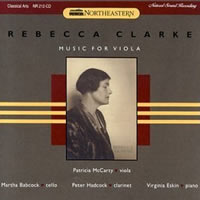
 Rebecca Clarke: Music for Viola
Music for Viola
Patricia McCarty, Viola
Martha Babcock, Cello
Peter Hadcock, Clarinet
Virginia Eskin,
Piano
"The winning piece, they said, was the work of a philosopher, the other that of a poet. "And you should have seen their faces," said Mrs. Coolidge, "when they saw it was by a woman!"
Alfred Frankenstein
from "Music Festival: Argentina's Composers Make Debut"
She billed herself as "Viola Player and Composer" and for many years was generally forgotten in both capacities. But during the first two decades of this century, she was acknowledged as one of the finest violists of the day and a composer of rare distincition. She was greatly esteemed for her playing in chamber music; her partners included Schnabel, Casals, Thibaud, Artur Rubinstein, Percy Grainger, Myra Hess, and George Szell. Rubinstein called her "the glorious Rebecca Clarke."
Clarke was born in Harrow, England, in 1886. Her father, an amateur cellist who wanted to have chamber music on tap in the family, supervised her early musical education. At the age of eight, Clarke was sent to learn the violin and soon was taking part in what she later called "horrible attempts" on the string quartet literature, with "Papa...in his glory, snorting and grunting over the high notes in the cello part and telling us all what we ought to do." Clarke's father also took her to concerts in London, where she first heard the Joachim Quartet and Eugene Ysaye, who became her idol. In 1902, Clarke went to the Royal Academy of Music to study the violin with Hans Wessely. The next year she began to compose songs, mostly to German texts and all heavily indebted to Brahms. After leaving the Royal Academy in the middle of her third year when her harmony teacher unexpectedly proposed marriage and her father made her withdraw, Clarke found in composing "a refuge, an outlet, and finally a passion" and began to dream of becoming a professional musician.
Contents
Sonata for Viola and Piano (1921)
- Impetuoso
- Vivace
- Adagio
Prelude, Allegro an dPastorale (1941) for viola and clarinet
- Prelude
- Allegro
- Pastorale
Two Pieces for Vioa and Cello (1930)
- Lullaby
- Grotesque
Passacaglia on an Old English Tune (1943) for viola and piano