

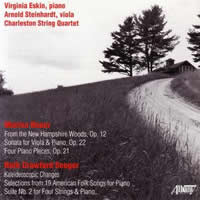
 Marion Bauer and Ruth Crawford Seeger
Virginia
Eskin,
Piano
Arnold Steinhardt,
Viola
Charleston
String
Quartet
Purchase individual selections from Albany Records.
Beach's virtuoso works for piano range from the technically playful to the digitally exhausting.
Marion Bauer (1882-1955) and Ruth Crawford Seeger (1901-1953) began their life-long friendship in the summer of 1929, when both enjoyed privileged living at the MacDowell Colony in Peterborough, New Hampshire -- a haven for Amercian artists since 1907. nothing to do but take care of your self and your work: lunch baskets dropped off at the door of your studio, dinners with writers, painters, and fellow musicians, walks through pine woods.
At a time when women in music had to face down Victorian stereotypes of dilletantism and sentimentality, the MacDowell Colony provided a "room of one's own." A Peterborough regular, Bauer came for her first visit in 1917. Within two days of arriving for what would be her only stay there, Crawford wrote how it was "glorious to be working again...I never knew the moon and stars would come inside me so."
Considering their historical reputations, few people would suspect the meeting points between these two composers, -- Bauer, representing what Carol Oja in her forthcoming book calls the "forgotten vanguard," and Crawford, known today as a pivotal figure in the radical "ultra-modern" movement. But back then, both believed strongly in the manifest destiny of a similar kind of modernism: both spent the 1920's exploring frontiers of harmony; both greatly admired Scriabin, taking his mystical impressionism as their starting point; and both were influenced by transcendentalist aesthetics. After hearing some of Bauer's piano preludes, Crawford recorded her impressions in her diary: "I am bewildered by the strangeness of the experience, [by our] affinities. Our manner of building, our feeling very strongly the spirit of our work, our strengths and weaknesses -- in all these, tho we are individuals, yet we are very close. Tho we have only just met, yet our spirits have been friends for years."
from Notes by Judith Tick
Author of Ruth Crawford Seeger. A Composer's Search for American Music
Contents
Marion Bauer
From the New Hampshire Woods, Op. 12
- White Birches
- Indian Pipes
- Pine Trees
Turbulence, Op. 17, no. 2
Sonata for Viola and Piano, Op. 22
- Allegretto
- Andante Expressivo
- Allegro
Four Piano Pieces, Op. 21
- Chromaticon
- Ostinato
- Toccata
- Syncope
Ruth Crawford Seeger
Kaleidoscopic Changes on an Original Theme Ending with a Fugue
Selections from Nineteen American Folk Songs for Piano
- Darby's Ram
- Boll Weevil
- What'll We Do with the Baby?
- Cindy
- Turtle Dove
- The Babes in the Woods
- Ground Hog
- Sweet Betsy from Pike
- The Three Ravens
- Mammy Loves
- I Ride an Old Paint
- Frog Went A-Courtin
Suite No. 2 for Four Strings and Piano
- Lento
- Leggiero
- Allegro energico